Your AI-built product took off. Now what?
One person with an AI agent can ship a product in an evening. Here is what happens when real users arrive, and how to keep it running without hiring a team.
One evening, one product
A few years ago, testing an idea took months and a team. Now one person with an AI agent can ship a working product in an evening. That is a big deal. More ideas get tested, more people get to build, and good ideas reach users faster.
AI-first builders often get laughed at by "real" developers. They shouldn't be. Code is getting cheaper every year. Ideas are not. A good idea, one that solves a real problem for real people, is still the rarest and most valuable part of any product. AI-first builders produce exactly that. They spot the problem, shape the solution, and put it in front of users while others are still writing specs.
Engineers can scale a product. But first, someone has to invent one worth scaling.
Then the users come
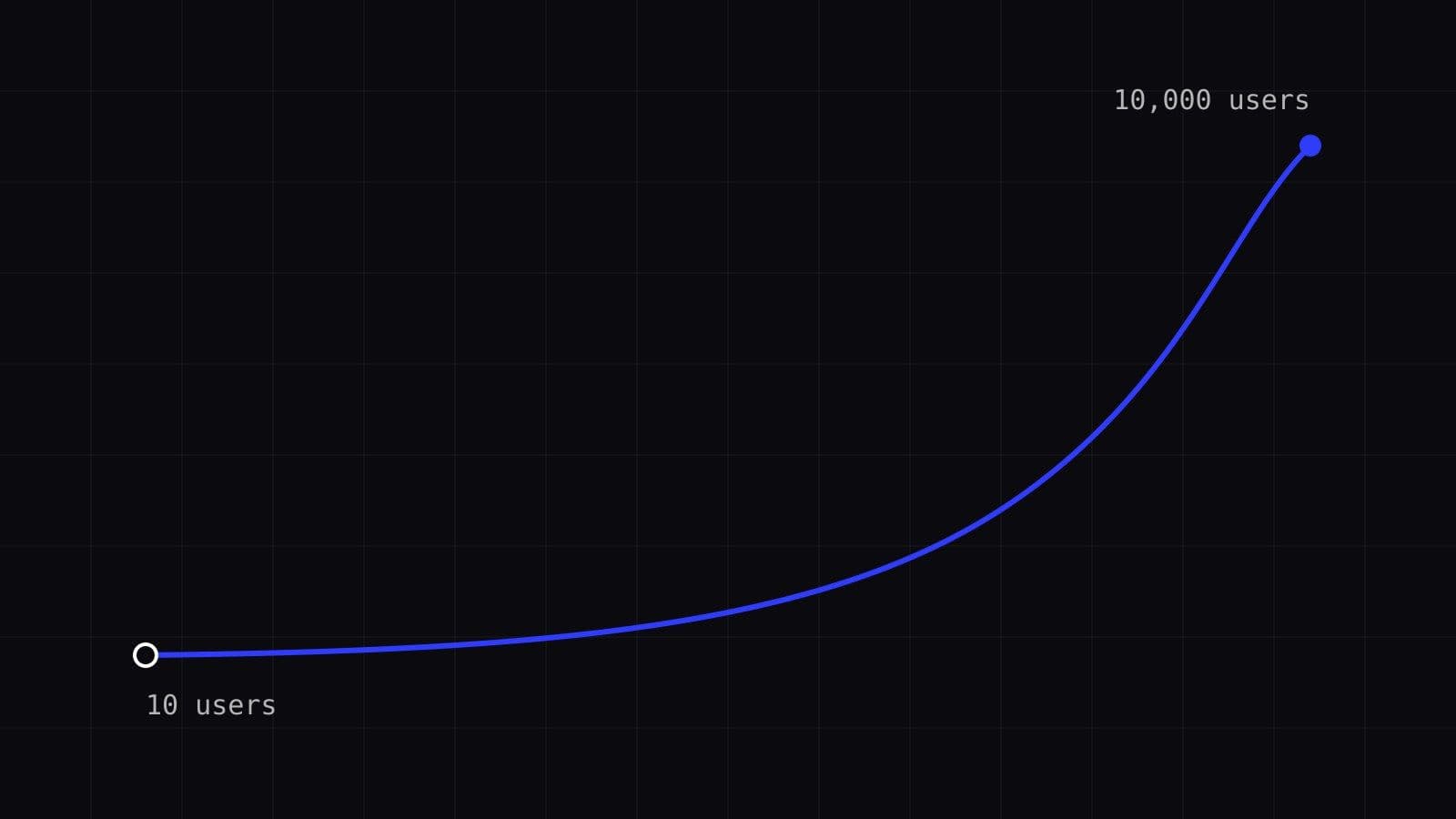
The problem starts with success. The product that worked for 10 users starts to fail at 10,000. Pages load slowly. The database locks up. A small change breaks three other features. Nobody knows why, because nobody wrote the code by hand.
Most founders panic here. They start hiring a full dev team. That costs time, because hiring takes months while users leave. It also costs money, because salaries run every month, even after the hard work is done.
Scaling is less hard than it looks. One experienced developer can get it done fast: a free review or audit first, then a fixed-price sprint, then support when you need it.
How the work gets done
1. Gather requirements
First, understand the product:
- What does it do, and who uses it?
- What load is expected now? How many users, requests, and how much data?
- How fast might it grow? Do we plan for 10x or 1000x?
- What must never fail? Payments, user data, core flows?
2. Design the system
Next, draw the system: what parts it has and how they connect. Typically:
- Frontend (web or mobile app)
- Backend API
- Database
- Cache
- Message queue and background workers
- File storage and CDN
- Third-party services (payments, email, auth)
The design shows where load hits first and what breaks if one part goes down.
3. Pick the stack
Then choose tools that fit the load, not the hype:
- Database: usually PostgreSQL. It handles most products for a long time.
- Backend: a structured framework like NestJS, Django, or Go services.
- Frontend: React or Next.js, often already in place.
- Cache: Redis.
- Queues: RabbitMQ, SQS, or BullMQ for slow or heavy jobs.
- Infra: Docker, a cloud provider, and infrastructure as code.
Often the existing code can stay. The goal is to fix the weak spots, not rewrite everything.
4. Scale from MVP to heavy production
The full chain usually looks like this:
- Audit the code. Find security holes, leaked secrets, and fragile parts.
- Add tests for core flows, so changes can't silently break them.
- Set up CI/CD. Every change is checked and deployed the same way.
- Split environments: dev, staging, and production.
- Fix the database: proper schema, indexes, migrations, backups.
- Secure it: real auth, secret management, rate limits, input checks.
- Make the backend stateless so you can run many copies behind a load balancer.
- Add caching for hot data and slow queries.
- Move heavy work to queues: emails, reports, AI calls, imports.
- Serve static files via CDN.
- Add monitoring: logs, metrics, error tracking, alerts.
- Load test to find the breaking point before users do.
- Scale the data layer when needed: read replicas, partitioning.
The main point: you keep vibe coding
Good help doesn't take your product away from you. It makes it safe for you to keep building the way you like.
That means:
- Instructions for coding agents (like CLAUDE.md or AGENTS.md) that explain the architecture, rules, and what not to touch.
- Tests and CI that block broken changes before they ship.
- Linters and strict types that catch agent mistakes early.
- Protected branches and preview environments, so you see every change before it goes live.
- Clear structure, so the agent knows where new code belongs.
Don't be afraid to build
Building something from nothing in one evening is a real skill. Don't let fear of scale stop you. If your product takes off and starts to crack, you don't need to hire a whole department. There are people who can help you fix it, set it up right, and hand it back to you ready to grow. Start with a free review.
Build first. Help is out there when you need it.